


1. What are the common laminating film specifications?
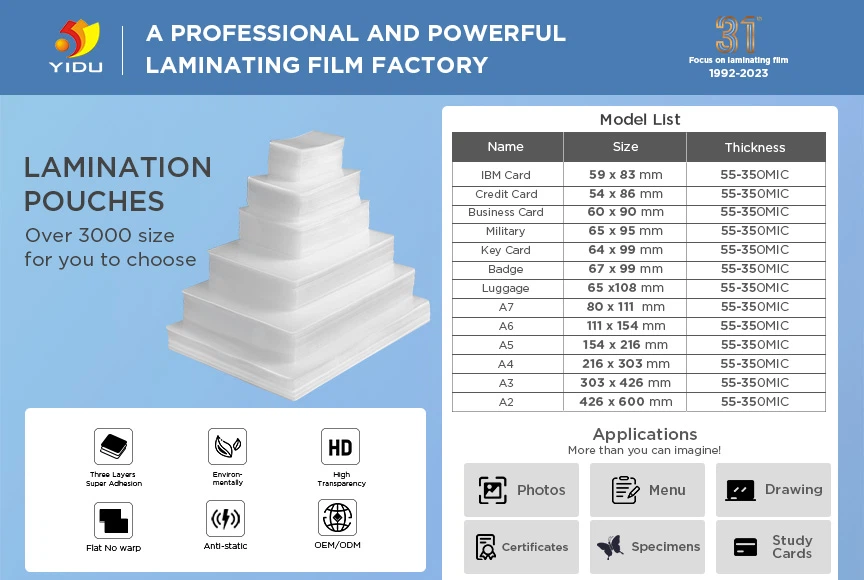
Answer: Laminating film is generally categorized by size:
A3 (297mm x 420mm)
A4 (210mm x 297mm)
A5, A6
Custom sizes for business cards, cards, photos, menus, etc.
In addition, wide-format laminating film (used for machine roll film) also comes in common sizes such as 30cm and 60cm, suitable for industrial or large-scale use.
2. How do I choose the thickness of laminating film?
Answer: Laminating film thicknesses typically fall into the following categories:
80 mic (0.08mm): Suitable for general documents and materials
100 mic: Suitable for general documents and IDs
125 mic and above: Suitable for menus and frequently used card items
3. What is the difference between heat-sealing and cold-sealing?
Answer:
Hot-sealing film (heat-sealing film): Requires heat for sealing, offers a secure seal, and offers high transparency, making it the mainstream choice in the market. Cold laminating film: Requires no heating and can be applied directly, making it suitable for temperature-sensitive materials (such as photos).
4. Are there environmentally friendly laminating films?
A: Yes. Reputable manufacturers typically offer laminating film made of PET and EVA. The non-toxic and environmentally friendly film is suitable for industries like education and healthcare.
5. What is the minimum order quantity?
A: Most manufacturers support small orders for standard stock sizes (A3/A4/A5, etc.). The minimum order quantity may be:
Full case shipment (minimum 1,000 sheets)
Custom sizes/logo printing require a higher minimum order quantity (generally minimum 5,000 sheets).
6. Does laminating film easily deform during transportation?
A: Reputable manufacturers use rigid cartons or pressure-resistant packaging to prevent the film from bending or getting wet during transportation. For larger quantities, we recommend:
Requesting pallet packaging
Using moisture-proof bags
Confirming courier/logistics shipping conditions in advance.
7. What is the shelf life of laminating film?
A: Generally, laminating film can be stored for 1-2 years at room temperature in a dry environment. However, please note:
Avoid direct sunlight, high temperatures, and high humidity. Prolonged storage may cause the edge sealing performance to deteriorate.