


In the process of purchasing laminating film, many buyers often focus on price, neglecting the direct impact of material selection on the final product quality and customer experience.
For wholesalers, distributors, and brand customers, choosing the wrong laminating film can lead to a series of problems, such as bubbles, wrinkles, weak seals after lamination, and even damage or fading during use.
Why is choosing the right laminating film crucial?
The role of laminating film is far more than just "a protective layer"; it is actually an integral part of product quality. In the end market, consumers often judge product quality based on visual appeal and feel, and the lamination effect is a key factor influencing this judgment.
Choosing an overly thin film may reduce costs, but it is prone to bending or breakage during use; blindly choosing high-specification products may lead to increased costs and reduced profit margins. Therefore, the correct choice is not the "most expensive" or the "thickest," but rather the "most suitable for your business needs."
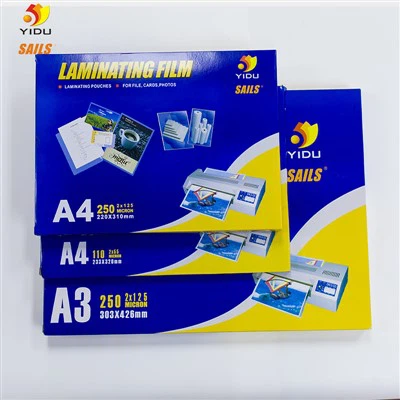
Total Thickness:250 mic (±5%)
Transparency:≥ 92% high light transmission
Laminating Method:Hot laminating
Manufacturer: YIDU

Size: A4 (216mm × 303mm)
Surface Finish: Matte
Packaging Specifications: 100 sheets/box (Customization available)
MOQ: 3000 boxes
Manufacturer: YIDU
Understanding Different Types of Laminating Film
Before making a choice, it's essential to establish a basic understanding. Different types of laminating film differ significantly in material structure, usage, and application scenarios.
By Material: PET vs. BOPP
PET laminating film offers high rigidity and transparency, resulting in a more structured and visually clearer finished product after lamination. It's suitable for applications such as photos, ID cards, and high-end display materials.
BOPP laminating film, on the other hand, prioritizes flexibility and low cost, making it more suitable for printing lamination and high-volume applications.
By Form: Laminating Pouches vs. Laminating Roll Film
Laminating pouches are pre-cut products, easy to handle, and suitable for office and standardized applications such as ID cards and photos.
Laminating roll film is primarily used in industrial or printing production, suitable for high-volume continuous processing, significantly improving production efficiency.
Classification by Surface Finish: Glossy vs. Matte
Glossy films enhance color reproduction, making images more vibrant, suitable for promotional materials and product displays; matte films offer anti-reflective properties, making them more suitable for readable documents or high-end printed materials.
Key Factors to Consider When Choosing Laminating Film
Application Scenarios
Different business scenarios have significantly different requirements for laminating film. For example, document and certificate protection requires higher durability and stability, making PET materials more suitable; while printing or packaging applications tend to choose lower-cost BOPP film.
Thickness Directly Affects Performance
3mil is suitable for basic protection, 5mil is a general specification that meets most application needs, while 7mil and above are suitable for scenarios requiring high-strength protection.
Higher thickness provides stronger protection, but also increases cost. Therefore, a reasonable choice should be made based on actual needs, rather than blindly pursuing the thickest specification.
Size and Specification Matching
Choosing a laminating film that matches the document size ensures a complete and aesthetically pleasing sealing effect. Common sizes include A4, A3, and photo sizes (e.g., 4x6).
Transparency and Visual Effects
For brand clients, visual effects often directly impact product value. PET film has advantages in transparency and gloss, while BOPP is more suitable for applications with relatively lower visual requirements.
Cost and Budget Balancing
During the procurement process, a balance needs to be found between cost and quality. For the high-volume market, choosing cost-effective BOPP products can enhance competitiveness; while for the high-end market, PET products can increase added value.
Selection Strategies for Different Types of Buyers
Wholesalers typically focus more on price and supply stability, thus standard-sized BOPP products are more advantageous. Brand clients, on the other hand, prioritize product quality and differentiation, tending to choose PET materials and engage in OEM customization. For OEM clients, the factory's customization capabilities and production scale are crucial; it is necessary to choose manufacturers with R&D capabilities and a stable supply chain.
Quick Selection Guide
For quick decision-making, consider the following principles:
* **Cost control priority:** Choose BOPP
* **Quality and durability priority:** Choose PET
* **For photos or ID cards:** Prioritize PET
* **For everyday office use:** BOPP is sufficient.
Get Professional Advice and Quotes
If you are looking for a stable and reliable Laminating Film supplier, we recommend choosing a manufacturer with large-scale production capabilities and extensive export experience to ensure product quality and supply stability.
Contact us for samples and customized solutions. We will provide professional advice based on your business needs to help you choose the most suitable Laminating Film product, achieving more efficient procurement and a competitive market advantage.