


Laminating film is a high-performance thin film material used to protect paper, printed materials, furniture panels, and other substrates. By covering the surface through a thermal or cold lamination process, it not only enhances the visual appeal and tactile experience but also improves durability, moisture resistance, scratch resistance, and anti-staining properties.
Proper preparation before lamination is crucial to avoid common issues such as bubbling, edge curling, poor adhesion, or film deformation. This article will provide a detailed guide on what to check regarding materials, equipment, substrates, environment, and safety before using laminating film.
1. Confirm the Type and Specification of Laminating Film
Choosing the right film material is the first step to ensure high-quality lamination. PET film is characterized by high strength, toughness, and excellent heat resistance, making it suitable for long-term use. Its continuous operating temperature ranges from 80–100°C, and it has anti-yellowing and UV-resistant properties.
PVC film, on the other hand, is flexible, cost-effective, and suitable for everyday document lamination or short-term use. However, it has lower heat resistance and may yellow or bubble over time.
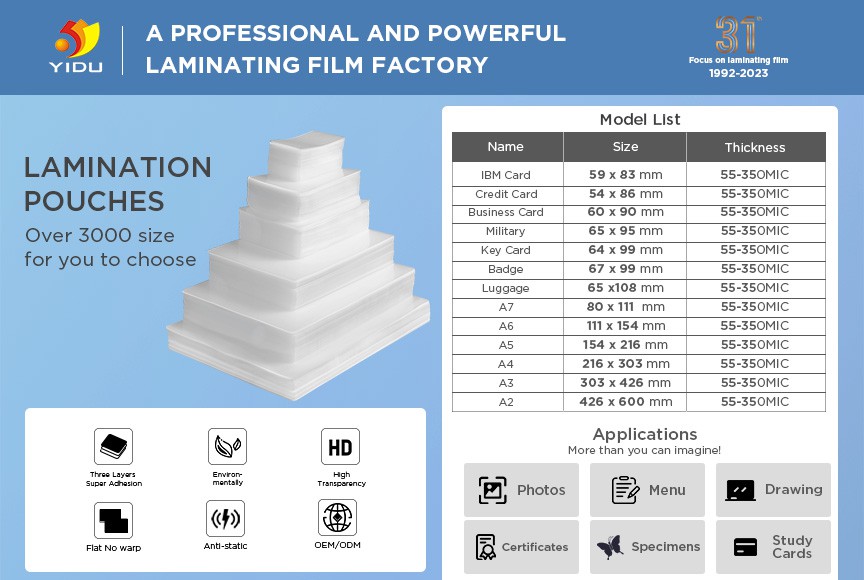
Film thickness should also be carefully selected. Common thickness ranges from 75–250 microns:
Thin films (75–100 microns): Ideal for documents or lightweight printed materials.
Medium-thickness films (100–150 microns): Suitable for photos or promotional materials.
Thick films (150–250 microns): Suitable for furniture panels or display materials.
Additionally, confirm whether the film is thermal or cold lamination. Thermal films require heat to seal, while cold films can be applied at room temperature. Understanding the lamination method is essential before use.
2. Check Equipment and Tools
Lamination quality heavily depends on equipment settings. For thermal films, the laminator must reach the proper temperature: 120–140°C for PET and 90–110°C for PVC. Pressure settings are equally important; too much or too little pressure can lead to bubbling or edge curling.
Before operation, clean the rollers and lamination platform to remove dust, paper scraps, or adhesive residue. Preheat the equipment until the temperature stabilizes. Ensuring consistent heat and clean surfaces is key to achieving smooth lamination.
3. Inspect the Surface of Substrates
The substrate surface directly affects lamination quality. Whether it is paper, printed materials, or furniture panels, the surface should be dry, clean, and flat. Dust, oil, or moisture can cause bubbles, localized swelling, or poor adhesion.
For furniture panels, confirm heat resistance to avoid deformation or discoloration during lamination. For paper and printed materials, avoid folds, curls, and creases, as these can result in unsightly finished products.
4. Conduct a Test Lamination
Before full-scale lamination, perform a small test on a corner or sample. Observe whether the film adheres evenly without bubbles, wrinkles, or edge curling. Based on the test, you can adjust the temperature, pressure, and speed of the laminator to ensure optimal results during full application.
5. Consider Environmental Conditions
Environmental factors significantly impact lamination quality. High humidity can cause bubbles, while low temperatures may lead to poor adhesion or edge curling. Ideally, perform lamination in an environment with temperatures around 20–25°C and humidity below 60%. Ensure good ventilation and minimize dust and static to maintain a smooth, even film surface.
6. Safety Precautions
Handling a laminator involves high temperatures, so safety is crucial. Avoid direct contact with heated rollers and plates to prevent burns. Wear protective gloves and goggles when necessary, especially when handling thick films or large panels. Keep clothing and fingers clear of rollers and moving parts to ensure operator safety and film integrity.
7. Common Problems and Preventive Measures
Bubbling: Usually caused by uneven substrate surfaces, dust, or moisture.
Solution: Clean the substrate, control temperature and pressure, and ensure film-substrate compatibility.
Edge Curling: Often due to film width being too narrow, high machine speed, or uneven roller heat.
Solution: Choose appropriate film width, adjust speed, and ensure even heating.
Poor Adhesion: Caused by low temperature, insufficient pressure, or incompatible film and substrate.
Solution: Adjust equipment settings according to film thickness and test on a sample.
Mastering these preventive measures can significantly reduce lamination failures and improve both efficiency and product quality.
8. Summary and Best Practices
Before using laminating film, confirm the film type and thickness, check equipment, clean the substrate surface, control environmental conditions, and perform a small test lamination. Following these steps ensures high-quality lamination, avoids common issues, and maximizes the protective, aesthetic, and functional benefits of laminating film. Proper use safeguards documents, printed materials, and furniture panels, providing reliable long-term protection.