


In the printing, packaging, office supplies, educational consumables, and commercial post-press processing industries, laminating film plays a critical role in protecting product appearance and extending service life.
When purchasing volumes grow from small trial orders to large-scale production, many buyers begin to realize that OEM laminating film is far more than simply adding a logo or changing packaging. It is a comprehensive process involving material selection, manufacturing technology, equipment compatibility, quality control, and supply chain management.
This article is intended to help buyers fully understand supplier capabilities, technical requirements, and customization considerations before placing bulk OEM laminating film orders, enabling more informed and rational purchasing decisions.
1. The Fundamental Difference Between OEM Laminating Film and Off-the-Shelf Products
Many buyers initially assume that OEM laminating film is simply standard laminating pouch film with customized branding or packaging. In reality, true OEM laminating film goes far beyond appearance-it involves film structure, adhesive formulation, production parameters, and long-term performance stability.
For bulk buyers, overlooking these factors can lead to issues such as edge curling, bubbling, inconsistent adhesion, or uneven clarity. These problems may not be obvious during small trial orders, but they become significantly amplified during continuous production and large-scale use, severely impacting productivity and final product quality.

2. Long-Term Stability Is the Most Critical Factor in Bulk OEM Laminating Film
During the OEM laminating film procurement process, many buyers focus primarily on unit price or short-term cost savings, while underestimating the importance of long-term stability across the production chain.
In reality, stability is the key indicator of whether a supplier is suitable for long-term cooperation, and it is reflected in three main aspects:
First, consistency of product performance.
In bulk OEM projects, even slight variations in film thickness or adhesive coating can cause laminating pouch film to wrinkle, bubble, curl, or adhere unevenly on high-speed laminating equipment. This increases waste rates, disrupts downstream production schedules, and may lead to customer complaints and brand damage.
Second, controllability of raw materials and manufacturing processes.
Professional OEM laminating film suppliers strictly control raw material sourcing, adhesive formulations, and thermal lamination parameters. This ensures consistency in transparency, heat resistance, and sealing performance across different production batches.
Third, reliability of delivery capability.
Bulk orders often require strict delivery schedules and quantities. Insufficient production capacity, unstable raw material supply, or inability to meet peak-season demand can directly disrupt production planning and business operations.
3. The Value of Customization in OEM Laminating Film
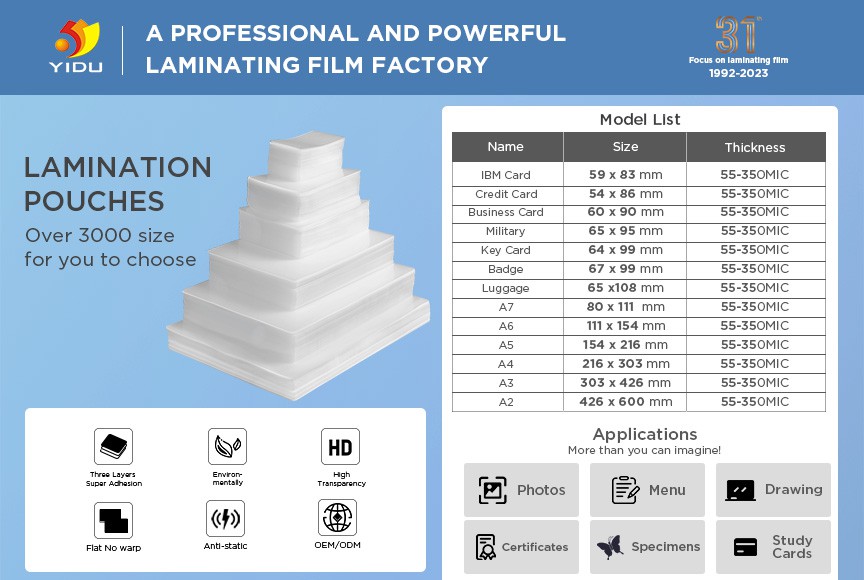
Specification customization is the core value of OEM laminating film. Film thickness, width, roll diameter, and core size directly affect compatibility with specific laminating equipment and overall processing efficiency. Inconsistent thickness can cause feeding issues or uneven sealing; incorrect roll diameters can lead to frequent roll changes or unstable tension. In mass production, these issues become magnified, impacting stability and product quality.
Film structure and surface finish selection determine both user experience and visual presentation. Gloss film, matte film, single-sided lamination, or double-sided lamination differ not only in appearance, but also in scratch resistance, fingerprint resistance, and the final presentation of laminated products.
Packaging and branding represent the lowest-cost customization element with the most immediate branding impact. Custom-printed cores, cartons, and labels do not affect film performance but significantly enhance brand recognition and market differentiation.
4. Key Indicators for Evaluating a Reliable OEM Laminating Film Supplier
Choosing a long-term OEM supplier means selecting a stable and dependable supply chain. The following factors are essential when evaluating supplier reliability:
1. Whether the supplier is a true manufacturer.
An experienced OEM laminating film supplier should operate in-house production lines, including coating, laminating, slitting, and packaging, with full control over quality monitoring and process traceability.
2. Ability to clearly explain technical parameters and processes.
A professional supplier should be able to clearly explain film thickness tolerances, heat sealing temperatures, substrate structures, and adhesive systems, rather than avoiding technical discussions or competing solely on price.
3. Emphasis on sampling and pre-production validation.
OEM cooperation is not about producing a single sample roll-it involves verifying production parameters, equipment compatibility, and real-world performance through testing.
4. Capability for long-term supply and quality traceability.
A mature OEM partnership requires not only smooth initial delivery but also consistent quality across future batches, supported by traceable production data and controlled processes.

5. A Typical OEM Laminating Film Cooperation Process
A professional OEM laminating film collaboration generally follows five stages:
Requirement confirmation:
The buyer clearly defines application scenarios, equipment types, target specifications, and estimated volumes.
Solution and quotation:
The supplier proposes a customized solution and quotation based on technical requirements, including material costs, production costs, minimum order quantities, and lead times.
Sample testing and adjustment:
Samples are produced and tested in real applications. Parameters are adjusted based on feedback.
Mass production:
After sample approval, bulk production is carried out according to standardized processes, ensuring every roll meets approved specifications and minimizing batch variation.
Delivery and long-term supply:
Products are delivered according to agreed schedules and quantities, while long-term supply planning and inventory strategies are established to ensure production continuity.
6. Conclusion
OEM laminating film procurement is not a one-time transaction-it is a long-term investment in supply chain stability, product quality, and brand reputation. Successful OEM partnerships typically share the following characteristics:
Long-term product performance stability with minimal batch variation
Smooth and efficient communication between buyer and supplier
Sustainable supply chains with reliable production capacity and delivery assurance
By fully understanding these factors before placing bulk orders, carefully defining customization requirements, and selecting experienced, capable, and reliable OEM laminating film manufacturers, buyers can transform OEM laminating film from a simple cost item into a core driver of product quality and brand competitiveness.