


Laminating film is a very common material in everyday office work, printing and packaging, and document storage. After lamination, it makes documents smoother, waterproof, stain-resistant, and enhances the overall texture.
Below, we'll guide you step-by-step through the key factors to consider when customizing laminating film.
1. Determine the Intended Use
Before customizing, you need to clarify the intended use:
* Documents and ID cards: We recommend choosing a glossy laminating film with high transparency and medium thickness (75-125 microns).
Photos and brochures: We recommend using high-gloss or matte film for a more aesthetically pleasing effect.
Packaging and labels: You can choose adhesive-backed laminating film or perforated laminating film for easy pasting and hanging.
Educational and presentation purposes: We recommend using anti-glare matte film to reduce reflections.
2. Choose the Appropriate Thickness
Common thicknesses for laminating film include:
75 microns (thin)
100 microns (standard)
125 microns (thick)
150 microns and above (industrial packaging)
Thicker films are more rigid and offer stronger protection; thinner films are more flexible and suitable for packaging large quantities of documents.
3. Determine the Surface Finish
Laminating film surfaces are mainly divided into two types:
Glossy: High transparency, vibrant colors, suitable for display documents;
Matte: Anti-reflective, anti-fingerprint, smoother feel, suitable for frequently touched documents or packaging.
Additionally, there are also special types such as adhesive-backed film, perforated film, and scratch-resistant film, all of which can be customized to meet specific needs.
4. Size and Packaging Customization
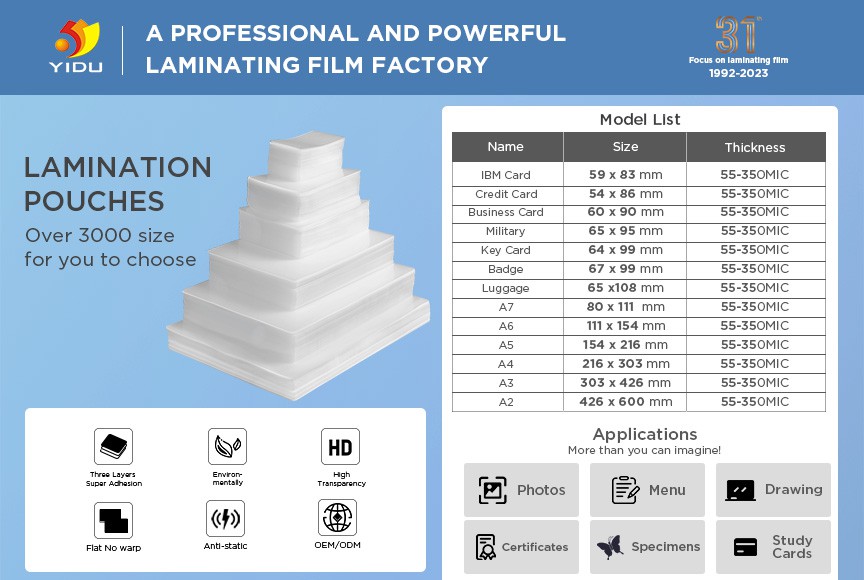
Common sizes include: A3, A4, A5, A6, etc.
If your product requires special sizes (such as cards, small labels, etc.), the factory can also provide custom cutting services.
Regarding packaging, options include: Neutral packaging (general export style) Private label packaging (with logo) Customized boxed or bagged quantities (50 sheets, 100 sheets, etc.)
5. How to Choose a Laminating Film Manufacturer
Buyers can consider the following aspects:
Production Experience: The longer the factory has been established, the more experience it has, and the more mature its production processes.
Production Capacity: Does the factory have sufficient production lines and inventory to ensure timely delivery of large orders?
Quality System: Has the factory passed ISO or other quality management system certifications? Are the products consistently stable?
Customization Capability: Does the factory support OEM/ODM, special sizes, thicknesses, and packaging customization?
Service and Response Speed: Is communication smooth? Can the factory quickly resolve issues or provide samples for testing?


6. The customization process generally includes:
Communicating requirements: Confirming specifications, thickness, usage, and packaging method;
Selecting a manufacturer: Choosing a reliable factory based on the criteria mentioned above;
Quotation and sampling: The factory provides samples and prices based on requirements;
Order confirmation: Mass production begins after sample confirmation;
Production and testing: The factory conducts rigorous quality testing;
Packaging and shipping: Finished products are boxed and shipped for export.
Want to customize your own Laminating Film? Contact us!
If you wish to purchase in bulk or customize Laminating Film with your brand logo, please contact us for samples, quotations, and customization solutions.