


In the office, printing, and packaging industries, laminating film is an essential material for protecting documents, certificates, and products. Choosing the appropriate laminating film thickness not only affects the protective effect but also the user experience and cost.
As a hot laminating film manufacturer with 32 years of R&D and production experience, we will analyze in detail the commonly used laminating film thicknesses, the advantages of each thickness, and how to choose the most suitable thickness.
1. Common Laminating Film Thicknesses and Characteristics
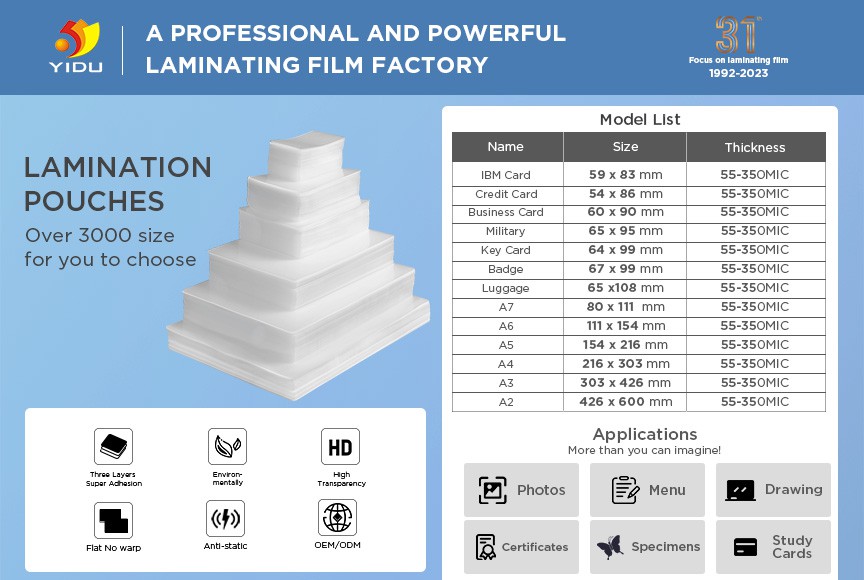
Laminating film thickness is usually measured in micrometers (μm), ranging from the most common 100 micrometers to 350 micrometers. Different thicknesses of laminating film have different applications, durability, and appearance. The common thicknesses are as follows:
1.1 100–125 micrometer Laminating Film
Applications: Primarily used for office documents, student assignments, certificates, and lightweight promotional materials.
Advantages: High film flexibility, easy to handle, easy to pass through laminating machines; low cost, suitable for large-volume daily office use; high film transparency, does not affect document readability.
1.2 150–175 micron Laminating Film
Suitable for: Documents, certificates, menus, brochures, and small posters requiring moderate protection.
Advantages: More durable than 100 micron film, with improved folding and abrasion resistance, effectively preventing everyday scratches and minor water stains; moderate thickness allows for smooth laminating machine operation and produces an aesthetically pleasing lamination result.
1.3 200–250 micron Laminating Film
Suitable for: Commonly used for important documents, professional display materials, menus, educational materials, and archival protection.
Advantages: Significantly enhanced durability, good folding and scratch resistance, allowing for long-term preservation of documents and materials; high transparency ensures good visual appeal, suitable for display applications; the thicker laminating film enhances the overall feel and texture.
1.4 300–350 micron Laminating Film
Suitable for: Primarily used for industrial applications, product packaging, long-term document preservation, high-end promotional materials, and ID card protection.
Advantages: Thick, excellent pressure and fold resistance, virtually tear-resistant, suitable for high-frequency use and long-term storage; enhances product texture and elevates its perceived quality; high transparency, with optional matte or fingerprint-resistant surface finishes.
2. How to Choose the Most Suitable Laminating Film Thickness
2.1 Choose Based on Usage Scenarios
For everyday office documents: such as worksheets, student assignments, or temporary materials, choose 100–125 microns; easy to use and low cost.
For certificates, credentials, and important documents: 200–250 microns is recommended, providing long-term protection while maintaining high transparency and texture.
For display materials: Choose 300–350 microns; effectively enhances the feel and perceived quality, suitable for high-end scenarios or frequently used materials.
2.2 Consider Storage Period and Durability
For documents with short storage periods or low usage frequency, choose a thin film to meet basic protection needs.
For documents or materials requiring long-term storage or frequent use, choose a medium-thickness or thick film to prevent folding, scratches, or tearing.
2.3 Consider the Performance of Laminating Film Equipment
Thick films are easy to handle and can be completed using ordinary office laminating machines.
Thick films require heating and pressure support from the laminating machine; high-end equipment can achieve uniform lamination, avoiding bubbles or unevenness.
2.4 Consider Cost and Performance
For everyday office use, prioritize films with high cost-performance.
For high-end displays, export products, or important documents, protection and quality should be prioritized, choosing medium-thickness or thick-thickness films.
This blog aims to help you fully understand how to choose the thickness of laminating film, allowing you to select the most suitable laminating film for office, display, or product packaging. Mastering this knowledge will enable you to make informed decisions, improving work efficiency and product quality, whether for everyday document packaging or high-end customized applications.
