


In the printing, packaging, stationery, and archival preservation industries, heat Laminating Film is a core material ensuring product quality and durability. Whether it's protecting archival documents, enhancing the aesthetics of gift packaging, preventing wear and tear on tickets and cards, or ensuring the long-term use of credit cards and identification documents, the performance of the film directly determines the quality of the final product and the customer experience.
Choosing a reliable heat Laminating Film manufacturer not only guarantees consistent film quality and performance but also ensures a controllable supply chain and reliable delivery times, establishing a foundation for long-term cooperation between buyers and businesses and reducing production and operational risks.
This article will provide buyers with a complete manufacturer selection guide from the perspectives of procurement needs, production capacity, and customization capabilities.

Clarify Your Heat-Sealing Film Needs
Before screening suppliers, buyers must clearly define their own film application needs and technical specifications. This not only affects supplier selection but also determines the performance of the purchased product and the user experience.
Film Types:
Heat-sealing film: Requires bonding to the surface of printed materials through heat pressing or rolling. Suitable for document lamination, identification document protection, and tickets/cards.
Cold-sealing film: Adheses without heating, commonly used for gift packaging or quick protection.
Functional films: Such as scratch-resistant, anti-static, UV-resistant, and stain-resistant films, used in specialized industries or for high-end products.
Substrate and Adhesive Layers:
PET (Polyester film): High transparency and good toughness, suitable for high gloss and abrasion resistance requirements.
BOPP (Biaxially oriented polypropylene film): Lower cost and good stability, suitable for general document lamination or packaging.
Adhesive Layers: Commonly used are EVA or LDPE adhesive layers. Different adhesive layer formulations affect heat-sealing temperature, adhesion, and durability.
Thickness and Width:
Select the appropriate thickness (e.g., 80~250 microns) and width (customizable according to slitting machine or printer width) based on laminating equipment specifications and product application.
Performance Indicators:
Gloss, heat-sealing strength, tensile stability, water and stain resistance, and aging resistance directly affect user experience and product lifespan.
How to evaluate the production capacity of a laminating film manufacturer?
The production capacity and technological level of a laminating film manufacturer are core indicators for judging its reliability and long-term cooperation value. Factories with high capacity, advanced equipment, and precision processes not only ensure timely delivery of large-volume orders but also guarantee consistent performance of each roll of film, thereby reducing procurement risks and subsequent quality issues.
Coating and Thermal Lamination Production Line
The coating line is the core step in the production of thermal laminating film; its precision directly determines the uniformity of film thickness and surface smoothness.
High-precision coating equipment can strictly control the thickness and uniformity of the adhesive layer, avoiding uneven thickness, bubbles, or wrinkles in the film, thus ensuring heat-sealing performance and service life.
Multi-layer coating processes can laminate adhesive layers with different functions onto the same substrate, such as adding anti-scratch, anti-static, or UV-resistant layers, increasing the added value of the film.
The thermal lamination machine plays a crucial role in film production. Through precise temperature and pressure control, it ensures full fusion of the adhesive layer and the substrate:
Temperature control is accurate to ±1℃, ensuring uniform distribution of the heat-sealing adhesive.
Pressure regulation adapts to film materials of varying thicknesses, preventing uneven stress that could lead to warping or curling.
A cooling system ensures the film material is fully shaped before leaving the factory, preventing shrinkage and deformation.
Through these high-precision processes, the Laminating Film factory can produce high-quality thermal laminating film with uniform thickness, stable gloss, and high heat-sealing strength, ensuring the reliability and aesthetics of the final product during use.
Slitting and Packaging Production Line
After production, the film material needs to be slitting and packaged, a crucial step in ensuring efficient delivery of large-volume orders:
Multiple slitting lines can simultaneously process film rolls of different widths and lengths, supporting customized wide-width films or short rolls.
An automated control system precisely controls the cutting length, roll tension, and edge neatness, ensuring each roll meets customer equipment requirements and reducing equipment failure and material waste.
An automated packaging line achieves neat roll packaging, moisture and dust protection, and can add packaging labels and print brand or batch information according to customer requirements, ensuring safety and easy identification during logistics and transportation.
Efficient slitting and packaging capabilities not only shorten delivery cycles but also enable the handling of large orders or urgent replenishment, ensuring buyers receive the required film materials on time.
Understanding Customization Capabilities (OEM/ODM)
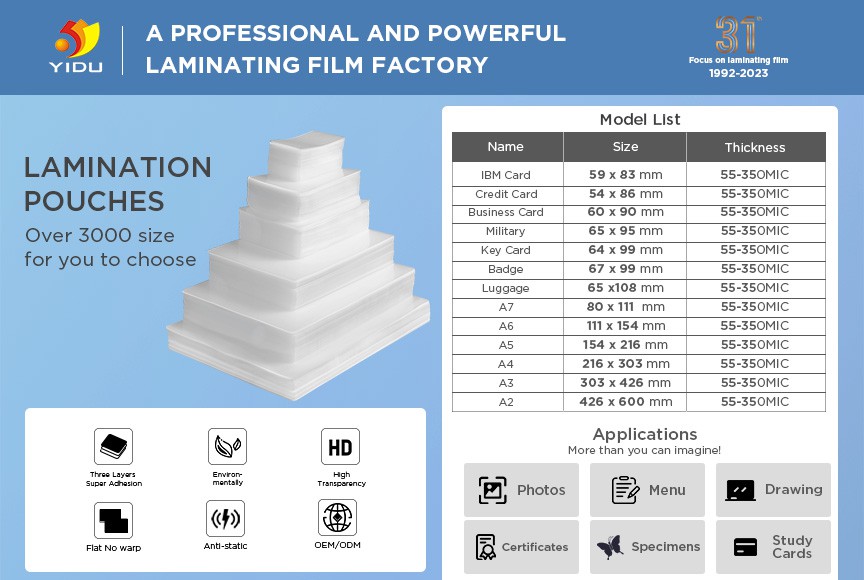
Laminating film manufacturers should not only provide standard-specification products but also possess strong OEM/ODM customization capabilities to meet the personalized needs of different customers in terms of function, specifications, appearance, and branding.
Film Material Specification Customization
Thickness Customization: Standard thermal laminating film thickness ranges from 80 to 250 microns, but some high-end printing or document protection applications require thinner or thicker films.
Width Customization: Slitting widths can range from tens of millimeters to hundreds of millimeters to meet the requirements of different printing equipment or automated laminating machines.
Roll Length Customization: Manufacturers can provide short or long rolls for different production lines or application scenarios, ensuring production continuity and efficiency.
Functional Film Customization: Such as double-sided glossy films, matte films, or hybrid films, suitable for specific printing effects or tactile requirements.

Functional Customization
Top manufacturers can add various functional treatments to standard films to meet the specific needs of different applications:
Scratch-resistant film: Enhances the film's surface abrasion resistance, suitable for documents, certificates, or high-frequency use scenarios.
Antistatic film: Reduces static electricity, improving the convenience of packaging and document handling, especially suitable for electronic product packaging.
UV-resistant film: Protects printed materials, photos, or certificates from fading or aging caused by UV exposure.
Matte/Gloss film: Enhances visual appeal, meeting the appearance requirements of high-end printed materials or gift packaging.
Special Functional Films: Such as peelable film, anti-fouling film, waterproof film, etc., for specific industries or customized projects.
Sample Verification and Technical Guidance
Reliable manufacturers typically provide sample verification and technical guidance services to ensure that customized films perform as required in actual use:
Sample Production: Provides customized film samples according to customer requirements, facilitating testing by the buyer in actual equipment or printing processes.
Process Parameter Optimization: Manufacturers can provide technical guidance on heat-sealing temperature, pressure, and cooling time to ensure that customized films achieve optimal results during use.
Performance Testing: Comprehensive testing including gloss, heat seal strength, tensile strength, scratch resistance, and antistatic properties ensures the film material meets customer expectations in terms of function and lifespan.
Private Label & Packaging:
Private Label: Customers can print their own brand directly on the film roll or packaging, enhancing market recognition.
Packaging Design Customization: Supports customer design of outer boxes, roll film packaging, and inner linings, ensuring safe transportation while enhancing brand image.
Printing Customization: Logos, batch numbers, instructions for use, or QR codes can be printed on the film material or packaging for easy inventory management and marketing.
Through brand customization, buyers not only obtain products that align with their brand positioning but also establish a differentiated advantage in the market.
Conclusion:
In summary, a truly worthwhile long-term Laminating Film manufacturer must possess stable and mature production capabilities, a comprehensive quality control system, flexible OEM/ODM customization capabilities, and transparent and controllable supply chain management.
If you are looking for a reliable Laminating Film factory, you can contact Yidu. Yidu is a Chinese factory with 32 years of R&D and production experience. It supports OEM/ODM customization and boasts an annual production capacity of 54,000 tons with 20 coating production lines, 50 cutting lines, and 15 packaging lines.