


Laminating film is widely used to protect and preserve important documents, certificates, photos, menus, teaching materials, and signage. High-quality laminating film helps maintain long-lasting clarity, durability, and professional presentation.
For schools, offices, print shops, and distributors, reliable laminating performance is essential. Poor-quality laminating pouches may cause bubbles, weak edge sealing, wrinkles, or film delamination, leading to higher replacement costs and reduced customer satisfaction.
With 33 years of experience in laminating film R&D and manufacturing, YIDU provides professional thermal laminating solutions for offices, schools, print shops, and commercial users worldwide. Choosing the right laminating pouch is essential for achieving clear appearance, strong sealing performance, and long-term document protection. In this guide, we'll explain how to select the best laminating pouch for office documents, certificates, photos, and other everyday applications.


What is Laminating Pouch?
Laminating pouch is a multi-layer protective film used for hot-melt bonding.
Laminating pouch consists of an outer layer of PET (polyester) and an inner layer of EVA hot-melt adhesive, forming a pre-cut structure widely used in office, education, and commercial printing industries.
Unlike ordinary plastic covers, laminating pouch requires heating and pressurization to melt the EVA layer, permanently bonding it to the document surface. After cooling, the laminating film hardens and seals, forming a protective barrier against moisture, dust, and physical abrasion that could damage the paper.
How the Laminating Pouch Film Process Works in Practical Applications
During the process, the document is placed in the laminating pouch film and passed through a laminator at a controlled temperature. The EVA adhesive layer melts evenly and covers the document surface, ensuring complete adhesion without bubbles or gaps.
If the material quality is unstable, problems such as uneven adhesive distribution or insufficient thermal response may occur, resulting in poor transparency or weak seal strength.
Why Laminating Pouch Film is Crucial for Office Documents and Certificates
Protective Function Extends Document Lifespan in Real-World Working Environments
In office environments, documents are frequently exposed to human handling, moisture, and dust, which significantly shortens their lifespan. Laminating pouch film forms a sealed protective layer, isolating external environmental factors and ensuring the long-term stability of the document.
Visual Enhancement Enhances the Perceived Value of Certificates
In addition to its protective function, lamination significantly enhances visual appeal, improving color clarity and surface gloss. Certificates, in particular, appear more formal and high-end after lamination, thereby enhancing the institution's credibility and brand image.
Types and Applications of Laminating Pouches
Glossy Laminating Pouches for High-Visual-Impact Materials
Glossy laminating pouches are designed to enhance color saturation and visual clarity, making them ideal for certificates, photographs, and marketing materials where high display quality is paramount.
Matte Laminating Pouches for a Professional Reading Experience
Matte laminating pouches reduce glare and improve readability, making them particularly suitable for brightly lit environments such as offices, restaurants, or public information boards.
High-Strength Laminating Pouches for Long-Term Industrial Use
High-strength laminating pouches, with a thickness between 150 and 250 microns, are designed for high-strength applications such as archival storage, industrial signage, and long-term display materials.
Their rigid structure provides excellent resistance to bending, moisture, and physical abrasion, making them suitable for harsh environments where durability is critical.

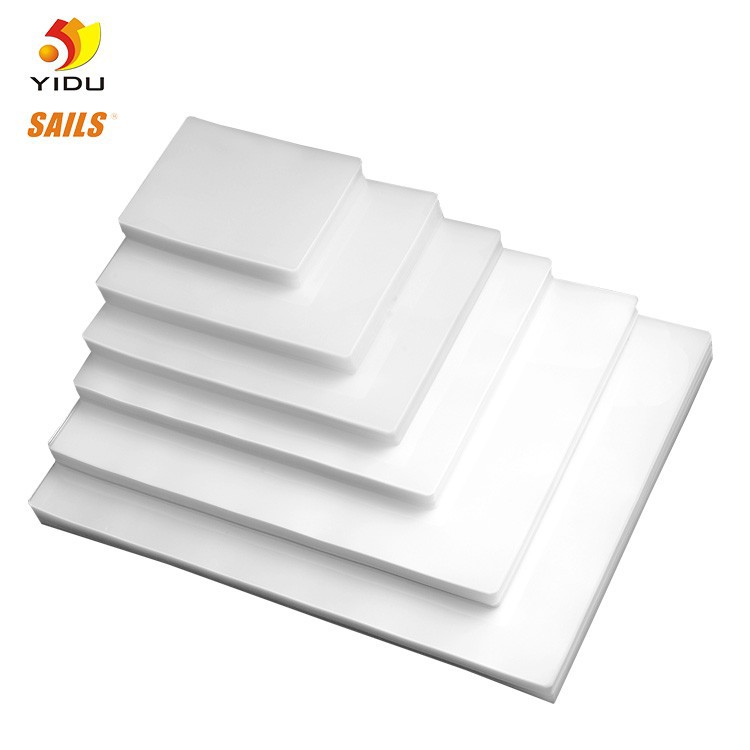
Thickness Selection
Thickness is one of the most important technical parameters in laminating film selection, as it directly affects the material's performance during the lamination process and the final document's shelf life.
80-micron laminating film is used for lightweight applications where flexibility is paramount.
100-125 micron laminating film is widely considered the industry standard because it achieves the optimal balance between flexibility and durability, suitable for most office and certificate applications.
150-250 micron laminating film is used for heavy-duty applications requiring long-term preservation and structural rigidity.
Inappropriate thickness selection can lead to wrinkling, poor sealing, and even machine feeding problems in high-volume production environments.
Material for Laminating Pouches
PET Provides Transparency and Structural Strength
PET is responsible for the transparency, rigidity, and heat resistance of laminating pouches. High-quality PET ensures that the laminated document remains clear and sharp, without fogging or deformation.
EVA Controls Adhesion and Bonding Stability
EVA, as a hot melt adhesive layer, is activated by heat. Its uniformity determines whether the sealing process is bubble-free and the adhesion is strong.
Poor EVA coating quality can lead to delamination, bubbles, or poor sealing performance, especially in high-speed production environments.
Application Scenarios
Office and Corporate Use
Suitable for contracts, reports, internal documents, and identification documents requiring long-term durability.
Education Industry Applications
For certificates requiring repeated use, teaching materials, flashcards, and classroom visual aids.
Food and Beverage Industry
Menu, price lists, and table displays, due to frequent contact with liquids and oils, require waterproof and easy-to-clean coated surfaces.
Retail and Brand Promotion Materials
Suitable for product cards, promotional displays, and brand advertising materials; visual appeal directly impacts sales performance.
FAQ
Q: What is the appropriate laminating film thickness for certificates?
A: 100–125 microns is the most commonly used standard thickness for certificates because it balances durability and aesthetics.
Q: What is the difference between glossy and matte laminating film?
A: Glossy laminating film enhances color brightness, while matte laminating film reduces reflections.
Q: Can you customize laminating film?
A: Yes, we support OEM/ODM customization.
Q: What is the minimum order quantity for laminating film?
A: Standard styles start at 1000 boxes.
Q: What types of customization do you support?
A: We support customization of thickness, size, logo, packaging, etc.